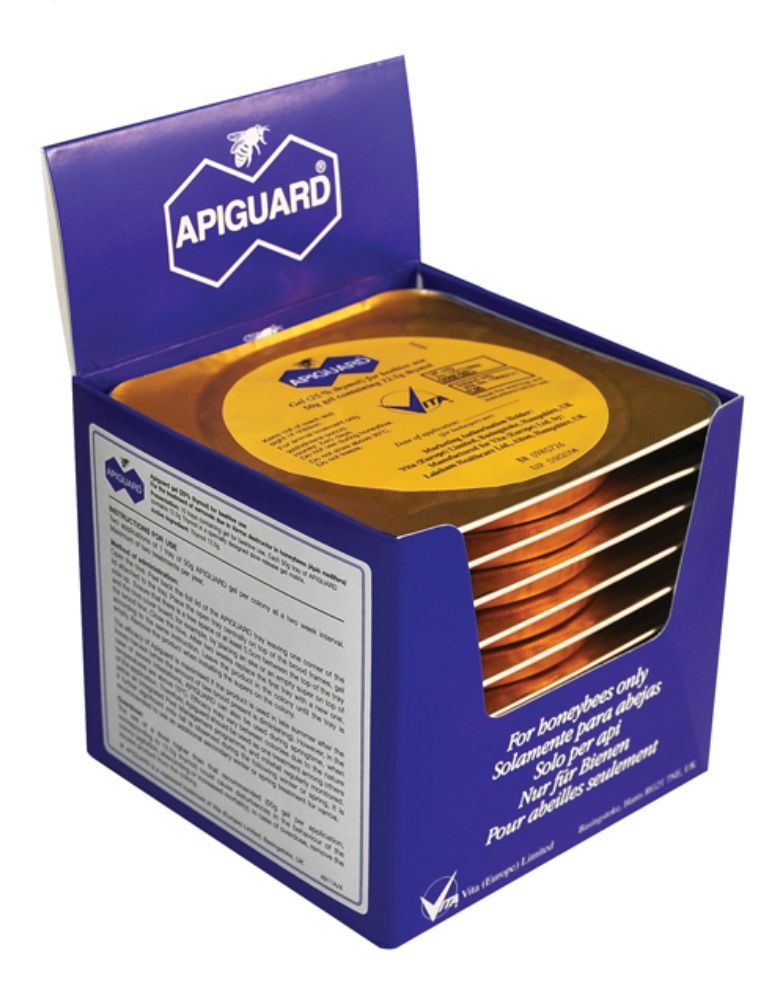
Apiguard
Share
SKU 11260
$64.55
Buy and save
Buy and earn $0.07 Loyalty for your next purchase
Loyalty is a discount program that lets you buy products and earn points to redeem on your next purchase. Your Loyalty balance is updated when you pay online or in-store. The Loyalty amount shown on this page can be recalculated at the checkout.
Pack Size
Please choose
In stock
Have questions?
Product details
Brand: Vita (Europe)
Apiguard is a non‑synthetic treatment for controlling Varroa destructor mites in honey bee hives. It is registered for use in Australia; always follow the instructions supplied with the product.
If your pack has an Australian label, use Apiguard strictly in accordance with that label. If it has an overseas label, follow the Australian permit conditions, which override any overseas directions. Varroa treatments are non‑returnable and non‑refundable, so please choose carefully.
Active ingredient
Thymol (monoterpenoid phenol)
APVMA approval
Permit: PER94655
Registration: 65570
Mode of action
Apiguard acts on the mite respiratory system, causing respiratory distress and failure. Rotate Apiguard with other Varroa treatments that have a different mode of action; do not rotate with other thymol‑based products.
Resistance risk
Considered low.
Targets
-
Mites on adult bees
-
Mites entering the hive
Chemical safety
Apiguard is classified as a Schedule 6 poison. It is irritating to skin and damaging to eyes, so avoid contact with eyes and skin. Wear elbow‑length chemical‑resistant gloves, cotton coveralls buttoned to neck and wrist, a washable hat, and protective eyewear or a face shield when handling or applying the product. Wash hands and personal protective equipment after use.
If poisoning occurs, contact a doctor or the Poisons Information Centre (Australia 13 11 26). If swallowed, do not induce vomiting. If on skin, remove contaminated clothing, wash skin thoroughly with soap and water, then with methylated spirits. If in eyes, hold eyes open, rinse gently with water for at least 15 minutes and seek medical advice. Apiguard is toxic to aquatic life; do not contaminate wetlands or watercourses.
Risk to bees
The second application of gel may disturb colonies and cause agitation or absconding. If this occurs, remove the additional gel.
Directions for use (summary)
-
Treat hives in spring before honey supers are added, or in autumn immediately after honey supers are removed.
-
Do not treat when maximum daily temperature is below 15°C, when colony activity is low, or when temperature is above 40°C.
-
Remove all honey supers before treatment.
-
Do not use in hives where comb honey is to be collected.
-
To avoid taste taint, do not treat during honey flow.
-
Do not feed colonies before treatment.
-
Combine weak colonies before treatment.
-
Treat all colonies in an apiary at the same time.
Always refer to the current APVMA directions and permit information for full instructions before use.
Apiguard
Share
Display prices in:AUD